Dried fruit on the Armenian New Year table: why Amanor means dried fruit, nuts and raisins
Sone Team6 min read
On an Armenian New Year table, dried fruit, nuts and raisins traditionally stood for abundance. Ethnographic accounts describe families setting out both fresh and dried fruit in the hope of a fruitful year ahead. Here’s how those foods were served and how to bring the tradition to your own table.
Contents
Why do Armenians put dried fruit and nuts on the New Year table?
An ethnographic article in the Armenian outlet Hetq describes the New Year’s table laden with dried fruit, fresh pears and apples, pomegranates, grapes and quince, which stood for fertility. The same article says raisins, nuts, almonds, aghandz (roasted hempseed and barley) and the holiday sweets called kaghand were always on the table.
The idea was simple: as the year begins, so it will continue. So the table had to be full, and families who had more set part of it aside for poorer relatives and neighbors.
The website of Armenia’s intangible cultural heritage says the same in other words: dried and fresh fruit, raisins and legumes were the main parts of the New Year meal, and fruit mattered a great deal.
What did guests get on January 1?
According to the same website, visitors on January 1 were met with symbols of plenty: nuts, raisins and small candies. Its list of required dishes names tolma, pancakes, kufta, vegetable salads, legumes, nuts, fruit and gata.
So dried fruit and nuts were not only decoration. They were what you gave to whoever came to wish you a happy new year.
What is anushapur and what is it made of?
Anushapur is the New Year’s sweet soup. The Hetq article says it was made everywhere from ground wheat, raisins, dried apricots and doshab, a fruit syrup.
In diaspora families anushapur is still the centerpiece of the holiday table. The Armenian Mirror-Spectator, writing in 2021, describes it as a wheat or barley porridge with dried fruit, nuts, sugar and pomegranate seeds. In Armenian families in Istanbul, the dessert table of fruit and sweets comes out at midnight, with anushapur at its center.
Every family cooks it its own way; what they share is wheat, raisins and dried fruit. If you make it at home, chop the dried apricots small so they spread evenly through the soup.

Also sold onWildberriesOzon
New Year customs in Artsakh and Syunik
Panorama.am, in 2015, described a custom of Artsakh and Syunik: a long string of walnuts, dried fruit and boiled chicken was made and lowered down the chimney of relatives, most often relatives by marriage.
The same article says the holiday pastries — the bread of the year, krkeni, kloch, purnik and other ritual breads — were round, square, triangular or other shapes, and were filled with walnuts, raisins, seeds and berries.
A story from the village of Meghrashen, told in the Mirror-Spectator, recalls seven kinds of dried fruit or sweets on the New Year table — as in 19th-century Western Armenia, in Palu for one, where seven foods were eaten on New Year’s Eve.
The bread of the year and gata
Bread had its own place at the New Year table. The Hetq article says the bread of the year was served to the family at the New Year’s Eve dinner, and the intangible heritage website says the ceremonial bread was baked on December 31. In Meghrashen, the Mirror-Spectator writes, a large round gata was an important part of the New Year.
The same newspaper mentions an old habit of hiding a coin in the holiday food; one family now puts a chickpea into one of the ichli kufta instead.
Dried fruit and nuts in diaspora homes
The custom traveled with families. One family from Malatya, quoted in the Mirror-Spectator, remembers New Year’s Eve as the time for nuts, oranges and special fruit they did not eat at other times of the year. In Istanbul, as above, the midnight table of fruit and sweets is built around anushapur.
Dried fruit before Amanor today
The habit holds in Armenia too. In January 2017 JAM News talked to a woman from Ejmiatsin who sold dried fruit before the New Year, both cooked in syrup and simply dried in the sun, and said friends and relatives living in Russia bought much of it that year.
Honey with the first toast
The Hetq article records one more custom: honey was offered with the first drink, so that everything in the coming year would be “sweet and honeyed.” A jar of honey on the table can be a small echo of it. Ours is on the honey page.
How to set out dried fruit for the New Year table today
Most of what these accounts list is easy to find now. A few practical points:
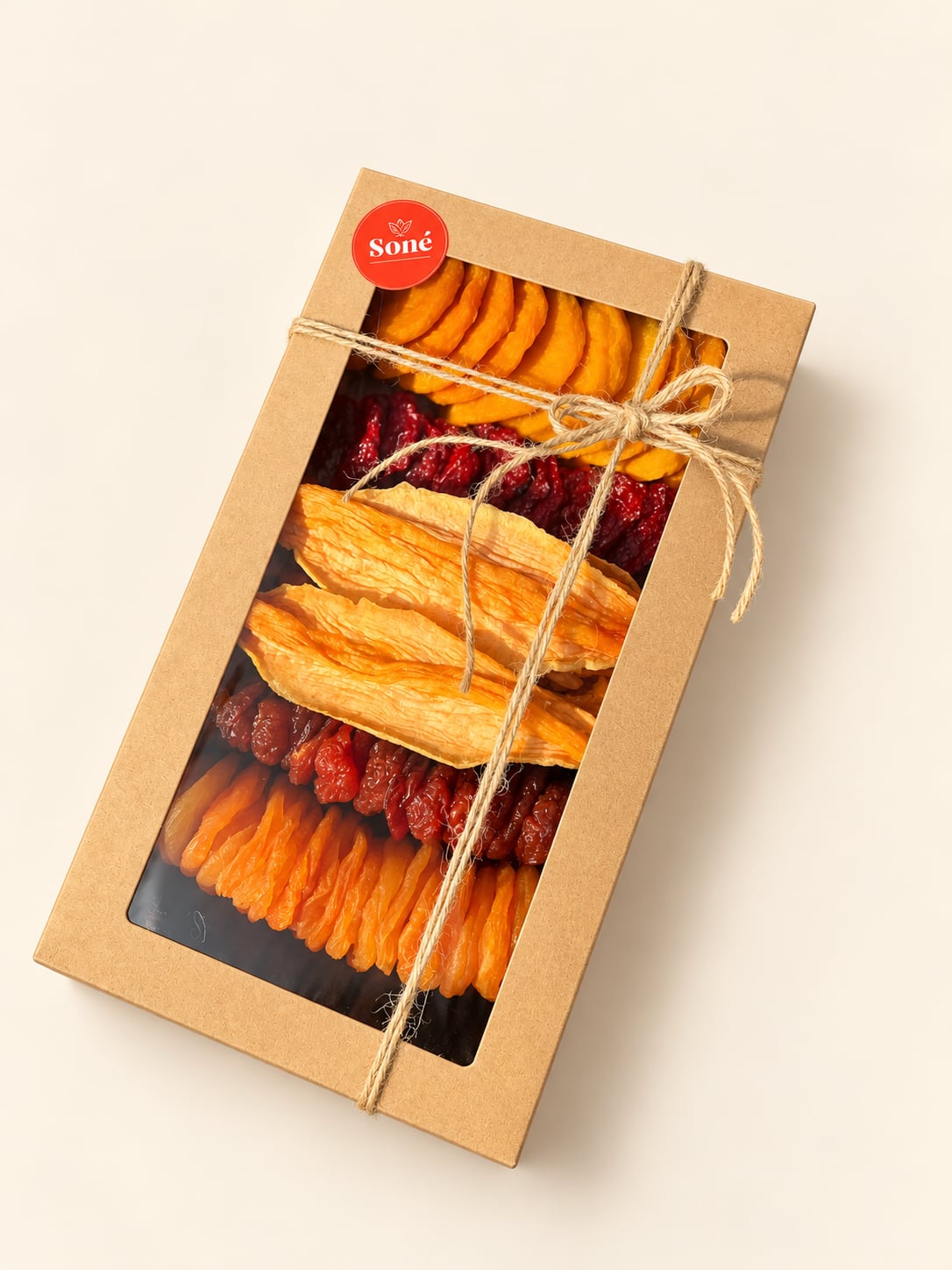
- Take several kinds. Apricots, plums, peaches, melon, raisins — different in color and taste, so the plate looks full.
- Put nuts and almonds on a plate of their own, or choose a box that has nuts in it. Some of our boxes include nuts and some do not; each box’s page lists what is inside.
- Keep the dried fruit in a closed box until the evening so it stays soft, and set it out shortly before guests arrive.
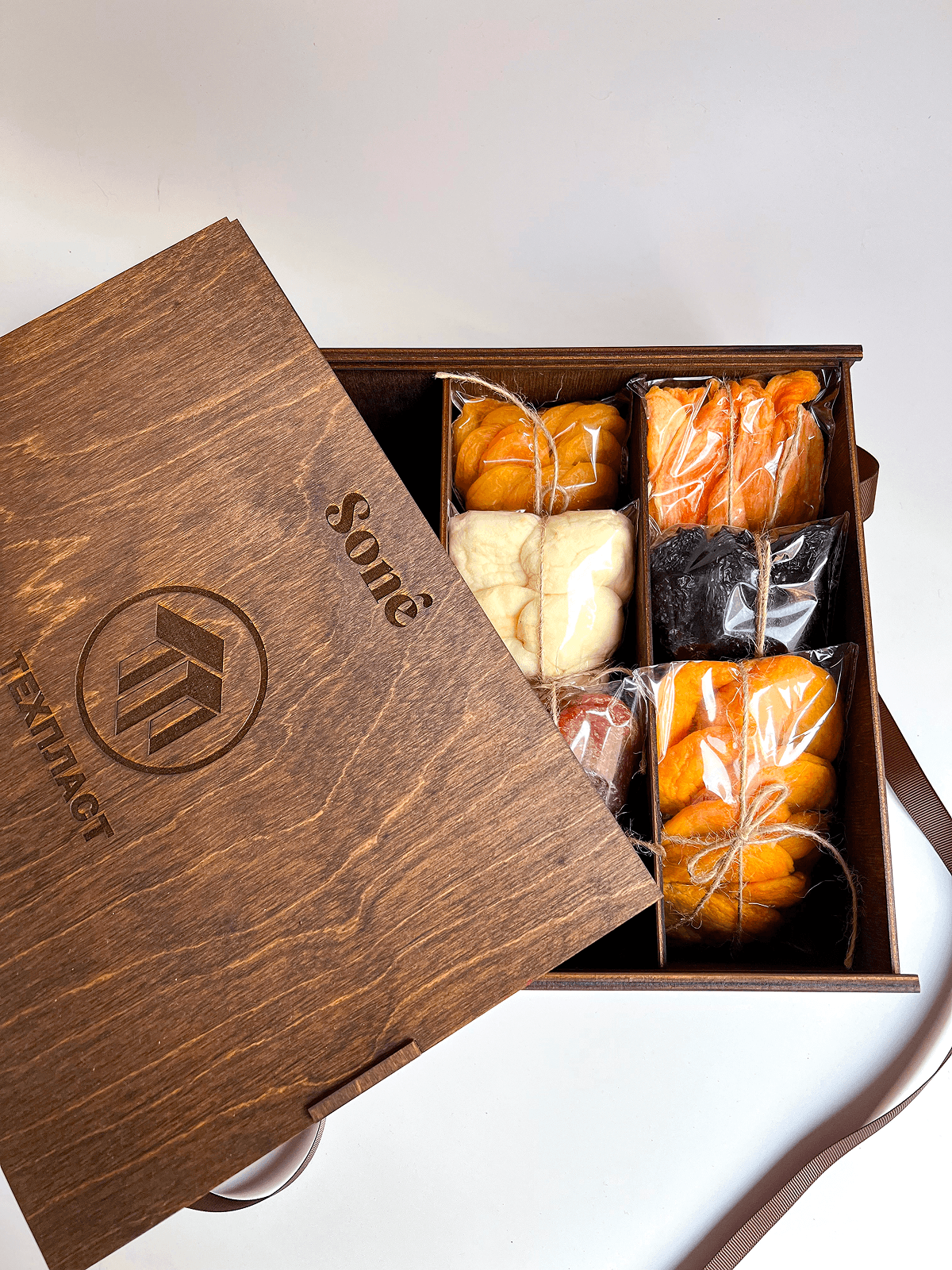
- Keep one box back for guests. Like the January 1 visit, a wooden box is easy to hand to whoever comes to wish you well.

Also sold onWildberriesOzon
Sone dried fruit is sun-dried, except apples, which are dried at low temperature. No added sugar; the fruit contains naturally occurring sugars. Most of our fruit is treated with sulfur dioxide, which keeps its color; black plums and apricot kernels are not.
Also sold onWildberriesOzon
In short
Dried fruit, nuts and raisins are on the Armenian New Year table because the table had to be full for the year to be plentiful. They went into anushapur, they were what guests got on January 1, and in Artsakh and Syunik they went down the in-laws’ chimney.
Dried fruit for the New Year table
- Gift boxesWooden and craft boxes, for the table and for guests
- All dried fruitApricots, plums, peaches, melon and more, in pouches